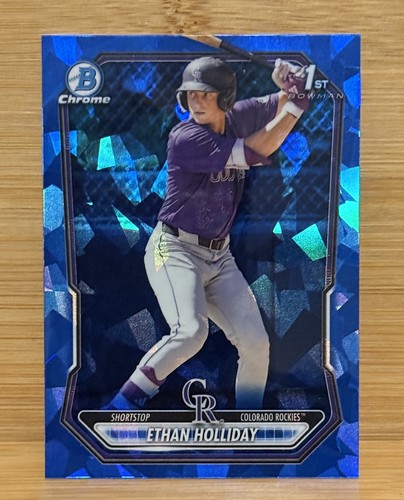
⚾ Baseball · 2026 Bowman Chrome Prospects

Ethan Holliday
Rookie Cards 2026

The #1 chase in 2026 Bowman. BCP-1 PSA 10 math, injury impact, exact re-entry window, and every parallel ranked by print run vs. upside. Son of Matt Holliday — the pedigree is real.

● Prices Updated June 2026 ⚾ BCP-1 Deep Dive 📊 PSA 10 Premium Math 🏥 Injury Timeline
Affiliate Disclosure: ShopCardHub earns commissions when you buy through links on this page (eBay Partner Network 3–4%). All prices are sourced from eBay completed and recently sold listings, June 2026. Card prices move daily — always verify current eBay sold comps before purchasing. This is not financial advice.
The Prospect

Why Ethan Holliday Is the #1 Card in 2026 Bowman

Three things converge: elite pedigree, elite tool set, and an injury discount that created a buying window. Here's what you need to know before touching a single card.

The Pedigree Factor

Ethan Holliday is the son of Matt Holliday, a 7× All-Star who slugged .492 for his career and won a World Series ring. Pedigree cards carry a collector premium that goes beyond on-field production — they create multi-generational narratives that sustain long-term demand. His older brother Jackson Holliday's BCP-1 trajectory is the direct comp: from sub-$100 raw to four-figure PSA 10 territory inside 18 months of a hot debut.

The Scouting Report
Holliday is a switch-hitting shortstop with 70-grade bat-to-ball and above-average raw power. Scouts project a 25–30 HR, .290 BA floor with 20+ SB upside. Plus defender at short or third. The rare five-tool package that commands premium card valuations.
📅
Draft Slot
Selected in the top 5 of the 2025 MLB Draft. BCP-1 is his flagship Bowman Chrome Prospects card — the format that has generated every major prospect card explosion of the last decade. First pick pedigree in BCP format is the single highest-floor speculative asset in the hobby.
🏥
The Injury Variable
Holliday dealt with a wrist/hand injury in early 2026 that slowed his stat line. This created the discount window many buyers have been waiting for. Injury-suppressed demand on a high-ceiling prospect is historically one of the best entry points in the hobby.
Injury Timeline

The Injury Window — And When to Re-Enter

Injuries create fear. Fear creates discount. Here's exactly what happened and what the market did in response.

Early 2026 — Spring Training
Wrist Discomfort Surfaces
Holliday begins experiencing wrist/hand soreness during spring reps. Symptoms managed initially. Not yet publicly disclosed — savvy holders quietly reduce exposure while casual buyers are still buying.
April 2026
IL Placement — Card Market Reacts
Official IL placement triggers a fast sentiment shift. BCP-1 raw comps drop 20–30% from peak. Auto BGAs and PSA 10s follow with a 2–3 week lag. Panic sellers flood the market. This is the beginning of the window — but not the bottom yet.
May 2026
Return to Action — Volume Pick Up
Holliday returns to game action. Early numbers are solid — no apparent swing-path degradation. Volume on BCP-1 raw picks back up as buyers sense the trough. PSA 10 prices stabilize. The floor-finding phase begins here.
June 2026 — Now
Re-Entry Window Is Open
Prices sit 20–35% below pre-injury peak with full return to health confirmed. This is the textbook re-entry zone: injury discount intact, health risk resolved, upside fully preserved. Raw BCP-1 gem candidates are the highest-ROI play right now.
Q3–Q4 2026 Catalyst
The Re-Rating Window
If Holliday produces a strong second half — particularly if he reaches AAA or gets a cup of coffee — BCP-1 PSA 10 has a clear path back to $500+ and auto PSA 10 to $2,500+. The risk/reward here strongly favors the buyer.
Re-Entry Signal: What to Watch For

Track Holliday's wrist health via beat reporters (not just official team statements). The two clearest buy signals: (1) 2-week stretch with exit velocities above 95 mph on pulled balls, confirming full wrist engagement; (2) promotion to AA/AAA, which historically triggers 40–80% price jumps on top-prospect cards within 30 days.

Ranked by ROI

Every Ethan Holliday Card — Ranked

Four plays, one clear hierarchy. Prices from eBay completed and recently sold listings, June 2026.

01
⚾ Best ROI Play · Bowman Chrome Prospects
BCP-1 Raw — Gem Candidate
eBay Sold Avg
~$85
Gem candidates $75–$95
PSA 10 Value
~$380
Upside Multiple
4.5×
PSA 10 Pop
Building
Risk Level
Moderate

The highest ROI play on the board right now. Raw gem candidates are cards that grade out at PSA 10 — centering 55/45 or better, four sharp corners, no surface scratches visible under 10× loupe. Buying gem candidates at $75–$95 and sending to PSA for a 10 grade unlocks $380+ in value, net of ~$30 grading cost. That's a $265+ gross return per card on a $30 grading investment.

The key skill here is pulling true gem candidates. Look for: center-focused print (the Bowman Chrome centering issue affects roughly 30–40% of pulls), no chipping on the black borders, and surfaces that stay clean under direct light at multiple angles. Reject any card with a visible print line or soft corner under loupe — PSA will catch it.

VERDICT: Buy Now. Best entry point since the set dropped. Injury discount is fully priced in. Health risk resolved. Grade the best copies, hold raw for secondary market if budget is tight.
View eBay Sold Comps → Shop Active Listings
02
⚾ High Upside · Bowman Chrome Auto
BCP-1 Autograph — Raw
eBay Sold Avg
$350–$550
Depending on centering
PSA 10 Value
$1,800+
Auto Grade Upside
3–4×
Pop (PSA 10 Auto)
Very Low
Risk Level
Moderate–High

The auto is the generational card. Holliday's on-card autograph is large, consistent, and clear — a good auto for grading. PSA 10 auto BCP-1 cards for top prospects with comparable pedigree (Jackson Holliday, Druw Jones) have cleared $2,500+ at their peaks. Ethan's auto PSA 10 pop is extremely low right now — this is an asymmetric bet.

The math: pay $400–$550 raw, grade at $30–$50, receive PSA 10, comp at $1,800+. That's a $1,250+ gross return if you pull a true 10. Note: Holliday's auto quality is consistent but you'll see some sloppier examples — inspect every single card before buying. Reject any ink skip, any letter that looks incomplete at the tail.

VERDICT: High-Conviction Buy for Patient Capital. You need budget and grading time (3–6 months), but the PSA 10 auto is the best asymmetric bet in 2026 Bowman for a healthy Holliday thesis.
View Auto Sold Comps → Shop Autos
03
⚾ Lower Risk · Already Graded
BCP-1 PSA 10 — Slabbed
eBay Sold Avg
~$380
Pre-graded, no wait
Upside to Peak
~$600+
Multiple from Now
1.5–2×
Time to Liquidate
Fast
Risk Level
Low

Buying a pre-graded PSA 10 eliminates grading risk and turnaround time. At ~$380, you're paying a premium over the raw gem candidate play, but you're guaranteed the result. Best for buyers who want liquid, marketable exposure to a Holliday breakout without the grading lottery. PSA 10 BCP-1 slabs trade easily and are the most common format for resale.

If Holliday hits AAA before year-end, $600–$700 on a PSA 10 BCP-1 is a reasonable Q4 target. That's a 60–85% return from current comps. Not as explosive as the raw gem play, but far more predictable.

VERDICT: Strong Buy for Risk-Averse Collectors. Pre-graded is the cleanest entry. You're buying the thesis, not the grading lottery.
Shop PSA 10 Slabs → View Sold Comps
04
⚾ Low Print Run · High Ceiling
Numbered Parallels — Blue /150, Purple /75, Gold /50
Range
$200–$2K
Depends on print run
Blue /150
$200–$320
Purple /75
$400–$650
Gold /50
$700–$1,100
Orange /25
$1,200+

Numbered parallels offer lower-pop-count exposure with collector scarcity premiums. The Blue /150 is the entry-level numbered parallel and the most liquid — easiest to buy, easiest to sell. The Purple /75 sits at the sweet spot of scarcity vs. affordability. The Gold /50 and rarer are for high-conviction holders only — illiquid but explosive on a breakout.

Important note: parallels do not necessarily grade at the same rate as base BCP-1. Bowman Chrome parallels often have different centering characteristics. Inspect centering on every numbered card — a /50 with poor centering is worth significantly less than a /50 gem candidate.

VERDICT: Hold or Buy Selectively. Blue /150 is the best entry. Gold and above are for patient money only — illiquidity risk is real if Holliday development stalls.
Shop Parallels → View Sold Comps
The Math

PSA 10 Premium Math — Every Grade Mapped

Here's exactly what each grade is worth right now and what the grade-up math looks like at current PSA turnaround costs. All figures from eBay completed sales, June 2026.

Grade Market Value vs. Raw Grade Cost Net Return Verdict
Raw (Poor) $30–$50 Don't buy. Not gradeable.
Raw (Mid) $55–$75 $30 Grade only if PSA 8/9 candidate Skip unless obvious 9+
Raw (Gem Cand.) $75–$95 $30 +$255 net (PSA 10 target) Best ROI entry
PSA 7 $55–$80 0.7× No. Below raw in premium
PSA 8 $100–$140 1.3× Skip. Weak premium vs. 10
PSA 9 $160–$220 2.1× Hold if you have one. Don't buy.
PSA 10 ⭐ ~$380 4.5× $30 +$265 gross The only grade worth buying
PSA 10 Auto $1,800+ $50 +$1,250+ gross Highest asymmetric bet
The PSA 10 Concentration Rule

On BCP-1 Holliday, the entire value thesis concentrates at PSA 10. PSA 8 and 9 carry marginal premium that doesn't justify buying over raw. If you're grading, you're grading for 10 or not grading at all. Any raw card that isn't a clear gem candidate (55/45+ centering, four sharp corners, pristine surfaces under loupe) should be sold raw or held raw — not graded. Grading a PSA 8 candidate is just paying $30 to discover a card worth less than you paid for it.

Print Run Hierarchy

BCP-1 Parallel Hierarchy — Full Map

Every parallel ranked by print run and estimated current market value. Rarer = higher ceiling, lower liquidity. Know the risk profile before you buy.

Base
UNLIMITED PRINT
$75–$95
↑ Best ROI
Blue
/150
$200–$320
Liquid
Purple
/75
$400–$650
Sweet spot
Gold
/50
$700–$1,100
↑ Patient money
Orange
/25
$1,200–$1,800
Illiquid
Red
/5
$4,000+
Trophy card
Superfractor
/1 — 1 OF 1
$25,000+
Generational asset
Liquidity Warning on Rares

The Gold /50 and below carry meaningful illiquidity risk. If Holliday's development stalls — another injury, slow stat line, or position change — rare parallels can sit unsold for months. The base BCP-1 and Blue /150 are liquid at almost any price point. The Superfractor and Red /5 are true trophy cards that effectively require a motivated buyer at a specific moment. Size your bets accordingly.

Strategy

When to Buy, When to Hold, When to Sell

The timing framework for every Holliday position.

🟢
Buy Now
Raw gem candidates ($75–$95) and auto raw cards. The injury discount is intact, health is confirmed, and the Q3–Q4 catalyst window is open. This is the best risk/reward period of 2026 for Holliday cards. Don't overthink it — buy the best copy you can find and grade or hold.
🟡
Hold — Target Exit
If you already own PSA 10 BCP-1 slabs, hold until one of two events: (1) AAA/MLB promotion announcement — sell into the spike on day 1–3, not after the hype fades; (2) $600+ BCP-1 PSA 10 comparable — that's your 60%+ return and a reasonable exit point if you bought at current levels.
🔴
Avoid / Wait
PSA 8/9 slabs, BGS 9/9.5, any card with visible centering issues. Also avoid buying after a news catalyst (promotion announcement, hot week stats) — those are sell moments, not buy moments. The best buys happen in boring weeks with no headlines.

Follow the Holliday Tracker

Live price updates, stat alerts, and PSA pop report changes as they happen.

Follow @shopcardhub
Related Reads

More From ShopCardHub